GROWTH DECISION STUDY / 01 — COMMERCIAL REAL ESTATE MARKETPLACE
When inventory disappears,search intent remains.
From friction spotted in a Growth meeting to systematic research, a hypothesis, and a product proposal ready to validate.
01 / TENSION
A search could end, but the user's need remained.
ARRIVAL
The user searches for commercial space with specific size and location requirements.

FRICTION
The property listing is no longer available. Navigation hits a dead end.

INTENT SIGNAL
The listing still holds signals such as property type, size, area, and rent.

CONTINUATION PATH
That context offers a way to continue the search without starting over.

02 / PROBLEM
The problem wasn't the listing. It was losing the context.
A user doesn't arrive at a listing by chance. They have size, area, and budget in mind.
When the listing disappears, the product discards all that context.
Search
Arrives with a size, area, and budget in mind.
Listing
Finds a relevant property.
Break
The property is no longer available.
Exit
There's no next action, and the search ends.
The intent is there.The interface stops.
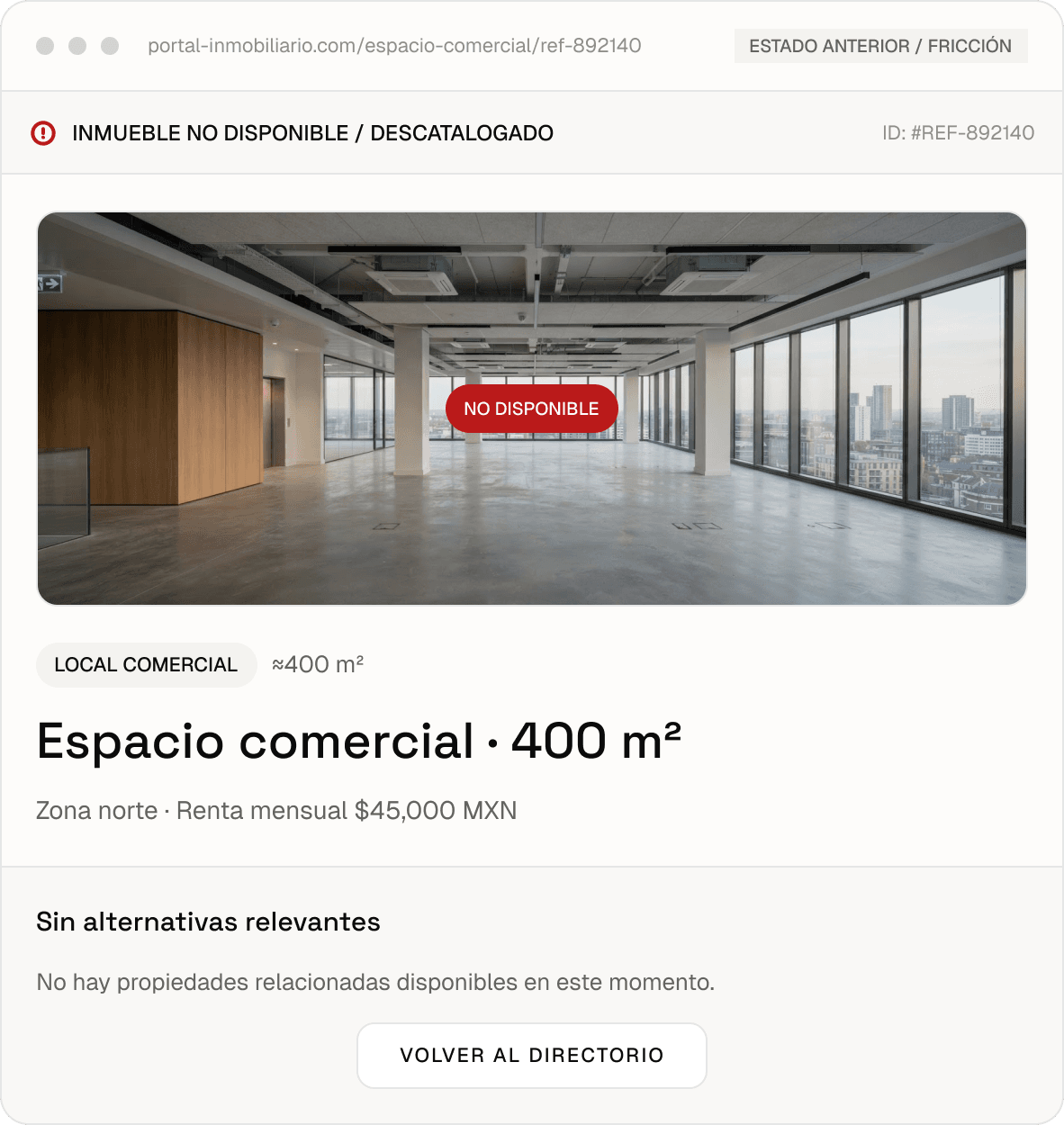
The concept interface above is shown in Spanish.
03 / RESEARCH
What signal existed before designing a solution?
01
Acquisition
Which terms attract the most qualified traffic?
Mapped long-tail organic queries for specific property types, high-demand commercial areas, and size ranges with clear transactional intent.
02
Inventory Cycle
How long is the average inventory gap?
Examined the delay between a property being occupied and its removal from search indexes, which brought a significant share of visitors to inactive listings.
03
Requirement Capture
How do users respond to unavailable inventory?
Behavioral review showed users reading property listings closely, looking for similar options before noticing that the property was unavailable.
04
Conversion
Users leave for external search engines
Exit analysis showed that a strong majority of departing visitors didn't use the internal search after the immediate frustration of an empty response.
04 / INSIGHT
The listing alreadyheld part of therequirement.
A shift in strategy and experience design before any technical development.
PREVIOUS APPROACH
What do we show when a property isn't available?
A passive approach: the system states its limit and puts the burden back on the user. The search context is discarded.
NEW APPROACH
How do we continue the search the user already started?
An active approach: preserve the property's parameters and open an assisted continuation path.
05 / HYPOTHESIS
What if the product continued the search instead of restarting it?

STARTING POINT
Reference photo of the property
If the product recognizes the original intent and presents relevant spaces, it can keep open a search that previously ended with no next action.
01 / INTERPRET
Extract intent
The product reads the original listing and extracts property type, approximate size (±30%), area, and rent range.
- Type
- Size ±30%
- Area and rent
02 / DECIDE
Check inventory
The system checks available inventory to determine whether relevant matches exist.
IF THERE ARE MATCHES
Explore available spaces
The product presents relevant spaces and keeps the search open.
IF THERE ARE NO MATCHES
Capture the requirement
If there are no alternatives, it records the requirement.
Personalized recommendations
06 / INTERVENTION
Turn existing context into a next action.
CURRENT STATE
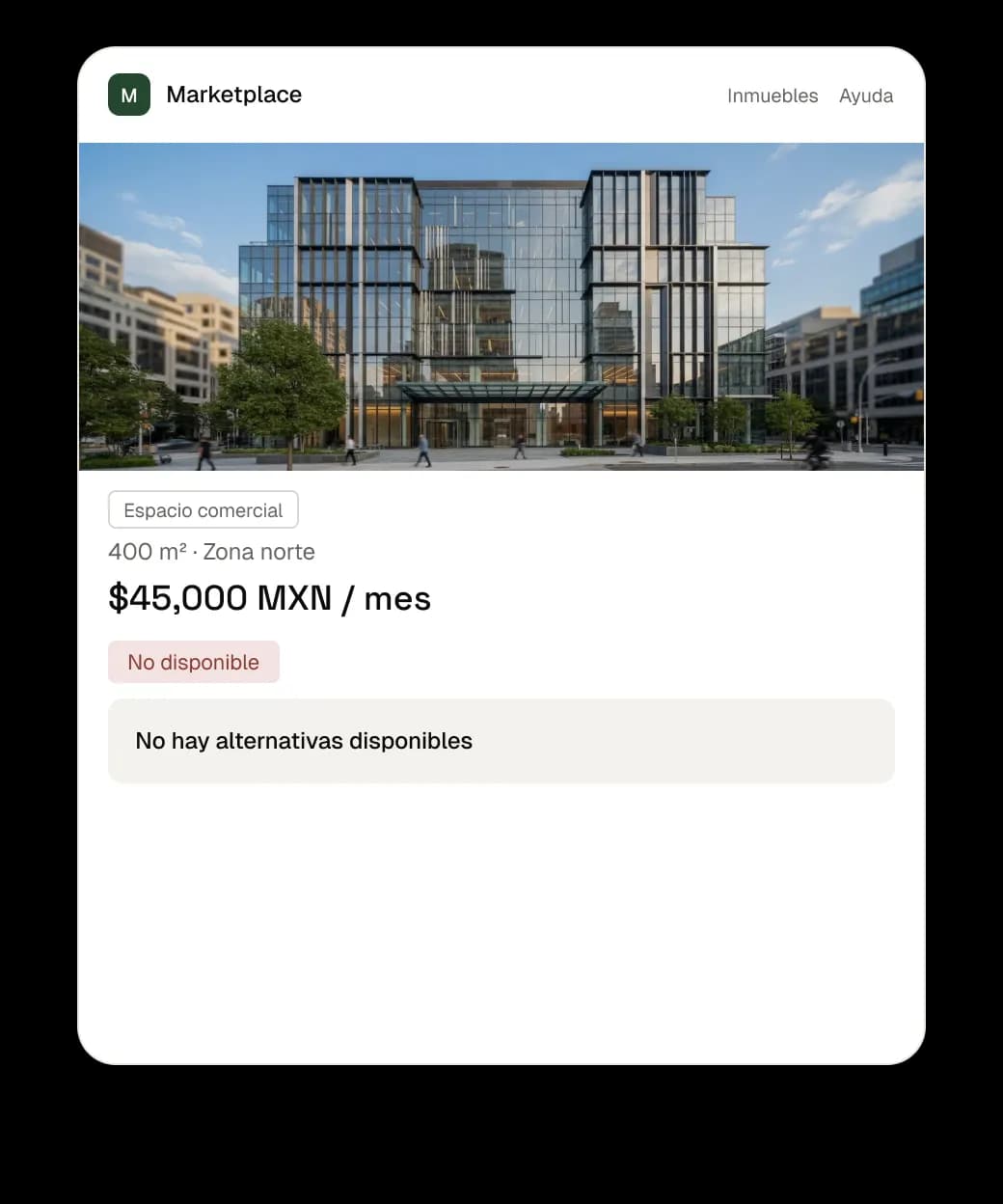
The interface ends before the search does.
CONTINUITY
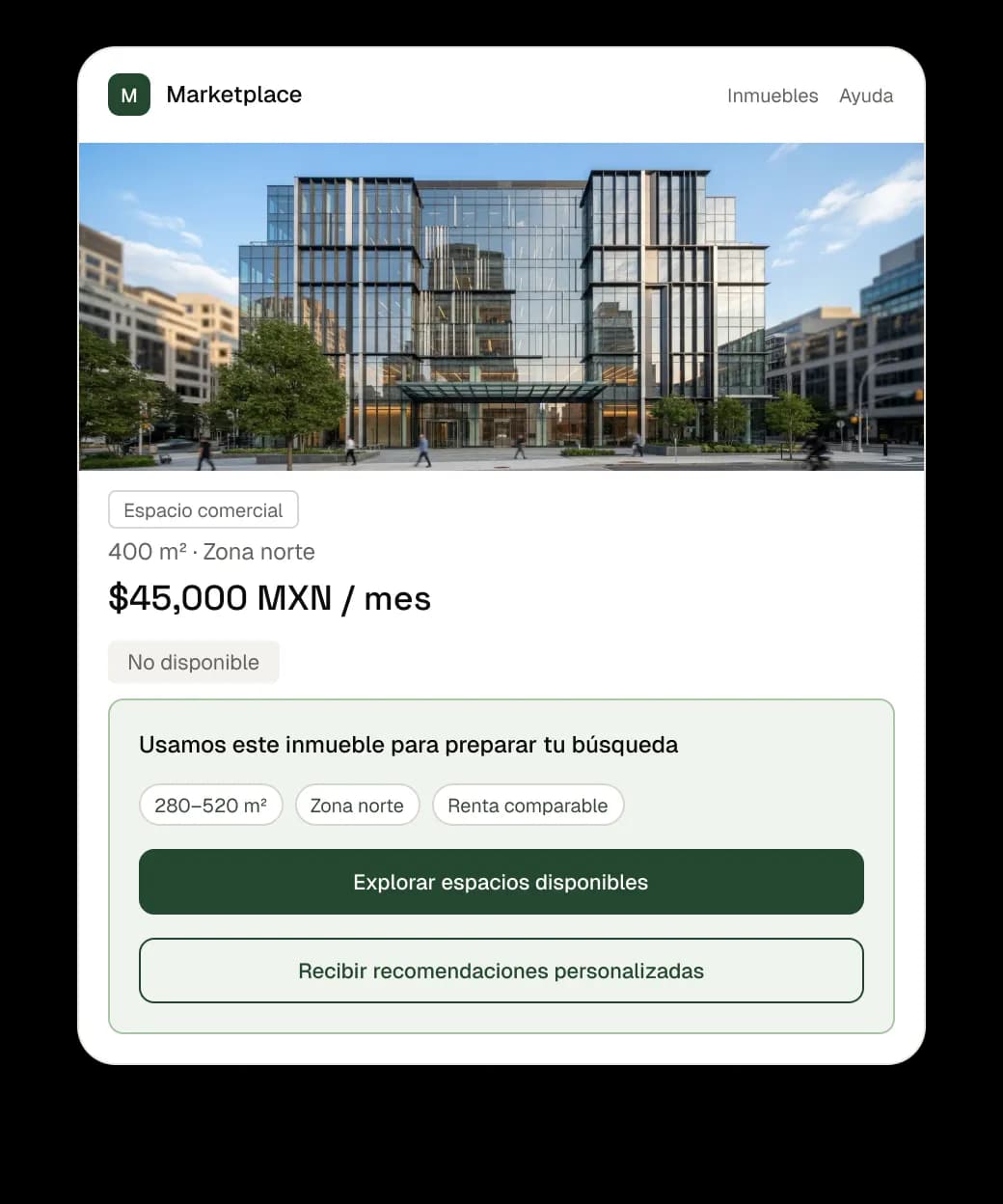
Existing context becomes a search ready to continue.
NO MATCHES
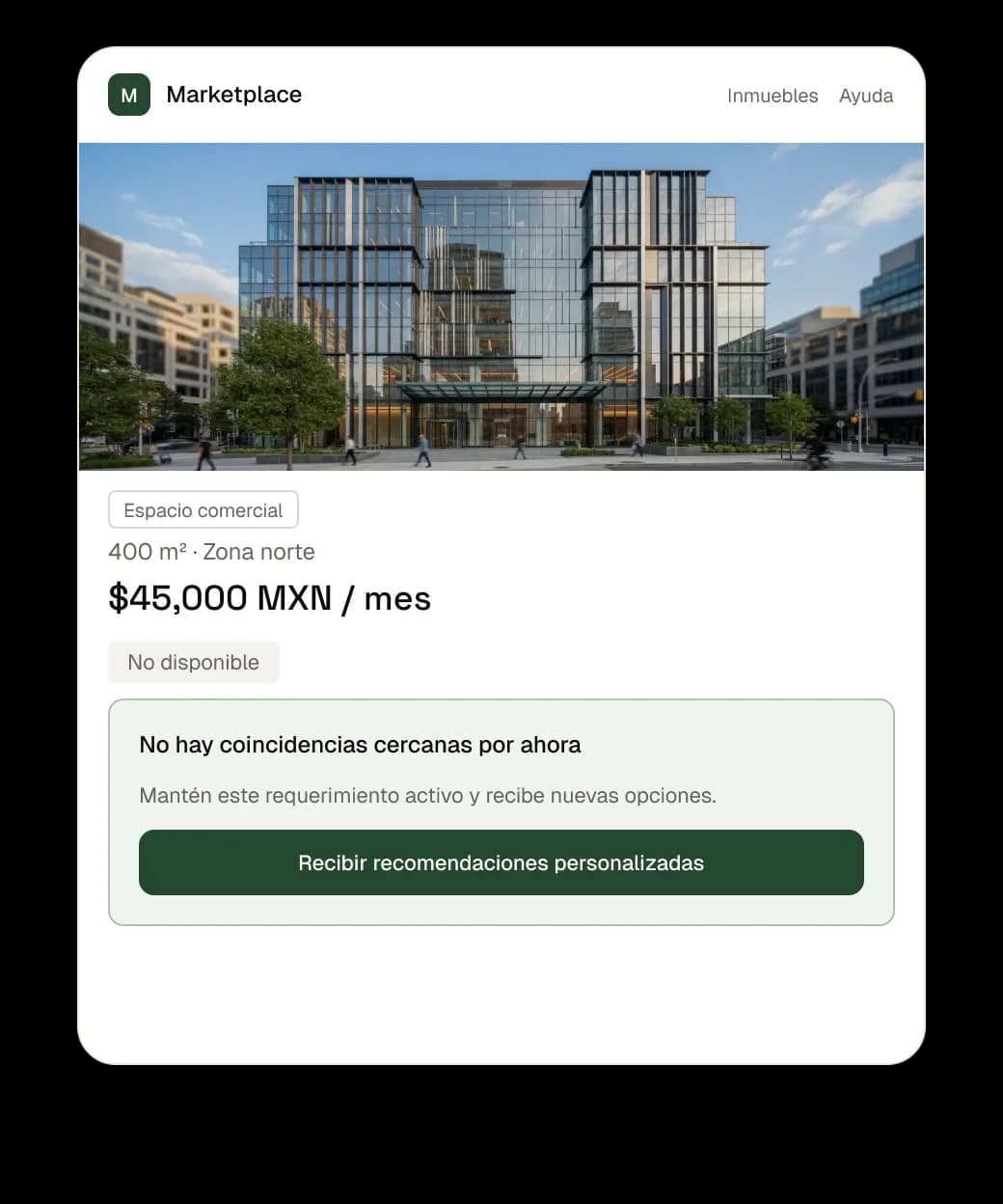
If there's no relevant alternative, the product doesn't promise one.
REQUIREMENT CAPTURE
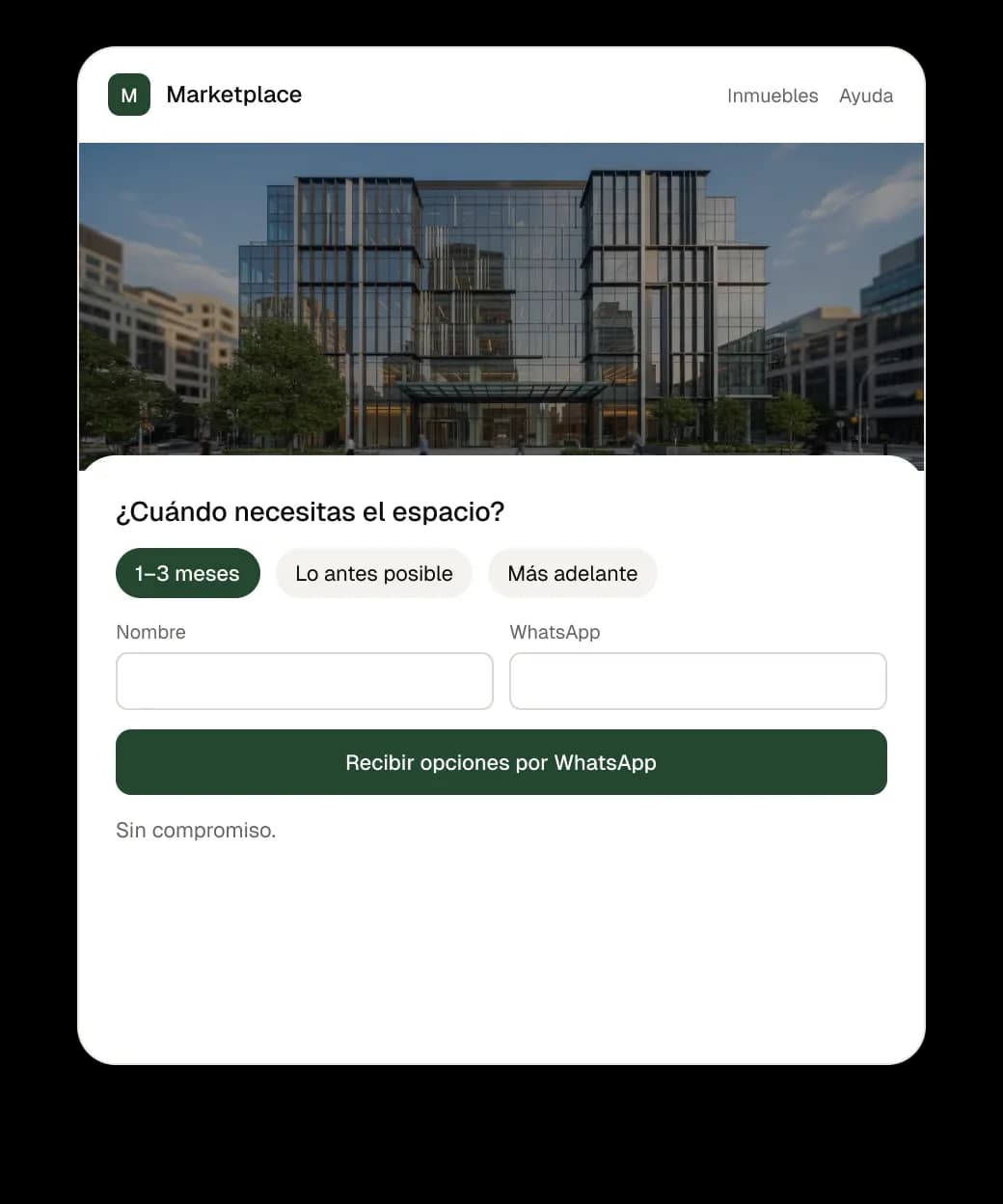
Ask only for what the listing can't infer.
Interface shown in Spanish — built for a Mexican marketplace.
RANGE DERIVED FROM THE LISTING
07 / LEARNING
I didn't design a screen. I designed an experiment.
Research
Understand where demand was lost and what signal already existed.
Design
Turn that context into a continuation path.
Validate
Define what to measure to know whether the hypothesis worked.
RESEARCH
- Map traffic to unavailable property listings.
- Analyze search attributes already present in each listing.
- Define the problem and recovery opportunity.
Research summary
DESIGN
- Architecture for unavailable inventory states.
- Intent recovery flows for desktop and mobile.
- Interactive prototype using the component system.
UI component system
VALIDATE
- Alignment among Growth, Product, and Operations.
- Explicit criteria for evaluating the hypothesis.
- Analytics instrumentation and event definitions.
Experiment protocol
DESIGN PRINCIPLE
Interpret first, intervene second.
WHY IT WAS WORTH TESTING
Conceptual diagram · doesn't represent measured values
01 / OPPORTUNITY
Demand already acquired
Some visitors already arrived with a defined need.
02 / LEVER
Context already available
The listing held enough signals to prefill the requirement.
03 / EVIDENCE
A more useful signal
Leads with defined requirements showed a substantially higher conversion rate.
Relative relationship · normalized values
FINAL LEARNING
In Growth, a signal doesn't immediately call for a new screen. It calls for better interpretation before deciding what's worth testing.
NEXT CONVERSATION
What's holding your product's growth back?
If you're seeing friction in conversion, activation, or experience, we can start by understanding what's happening and what is worth improving.
I want to improve my product