Sentinel OS
One person coordinating 50 autonomous AI agents. The interface that makes it possible.
Sentinel OS is an exception-based oversight system for fleets of AI agents. It was designed for a scenario where dozens of autonomous agents make operational decisions in parallel (sales, asset management, maintenance, and tenant screening) while a single human operator keeps strategic control.
Interface shown in Spanish.
Context
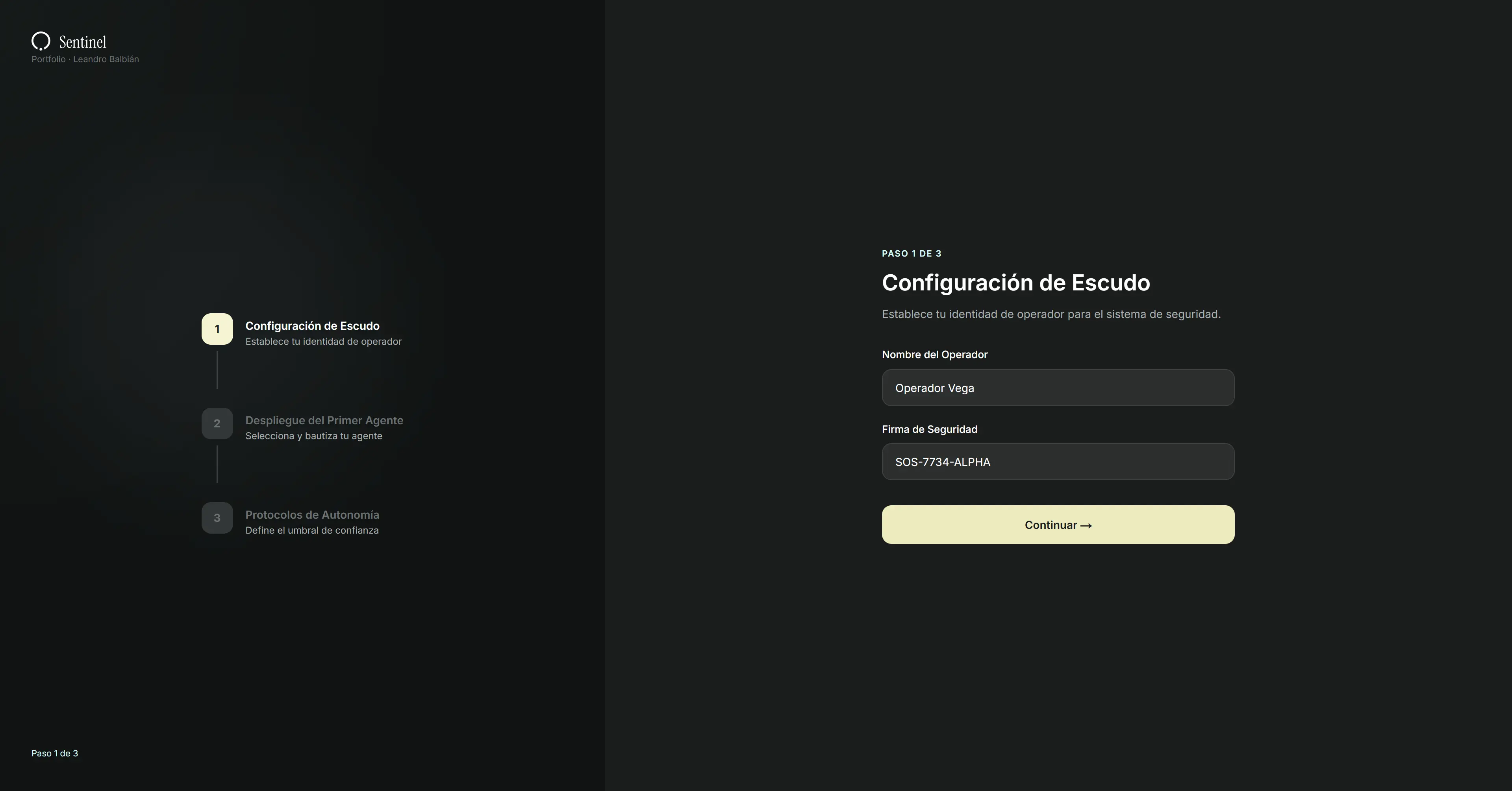
The interface starts from one concrete question: how can one person coordinate, trust, and correct 50 AI agents without getting lost in the noise?
The problem
As AI agents make more operational decisions, human teams lose sight of why each action happens. Without an interface built on traceable trust, operators can't tell which agent is making which decision right now, understand why an agent changed state, step in on time without stopping the whole operation, or audit where a critical decision came from.
Friction points
- Opaque autonomy: agents act without showing their confidence or their sources.
- No attention hierarchy: everything alerts with the same intensity, and nothing helps the operator prioritize.
- No operational traceability: when something fails, the decision path can't be reconstructed.
- Binary intervention: you can only let it run or stop everything; there's no gradual control.
- Invisible cascading risk: one agent with corrupted data can spread errors across the fleet.
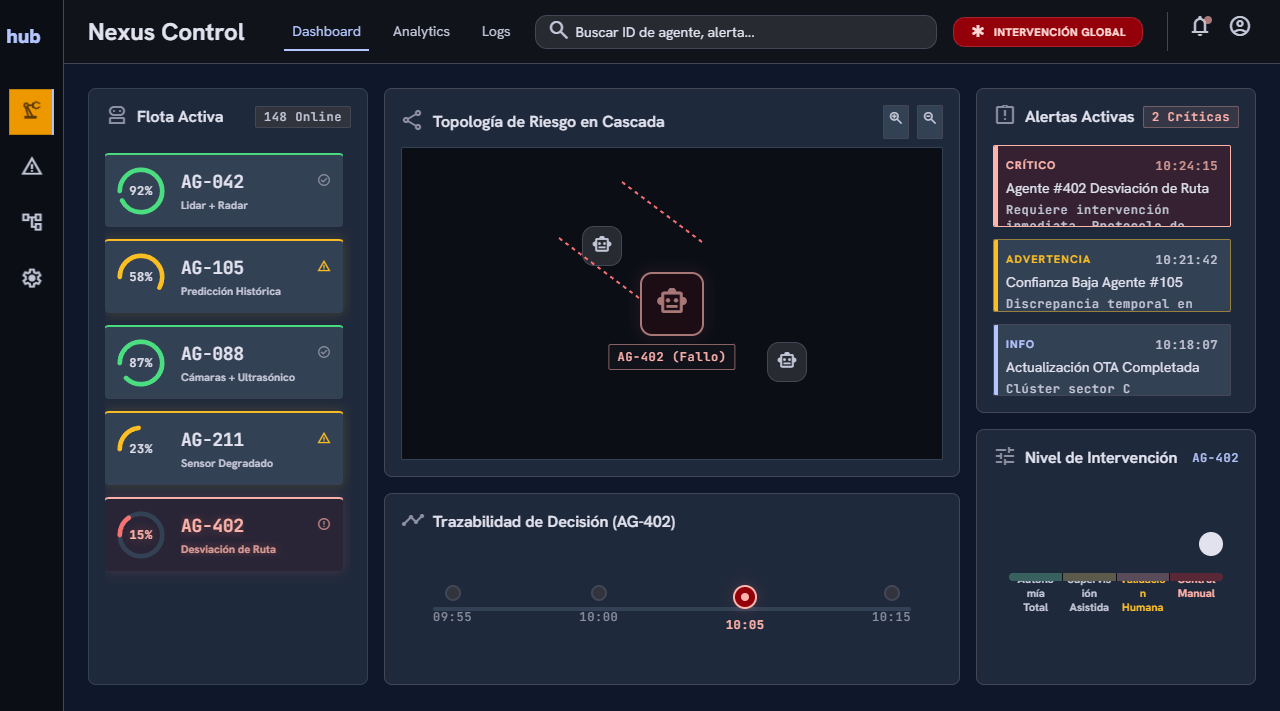
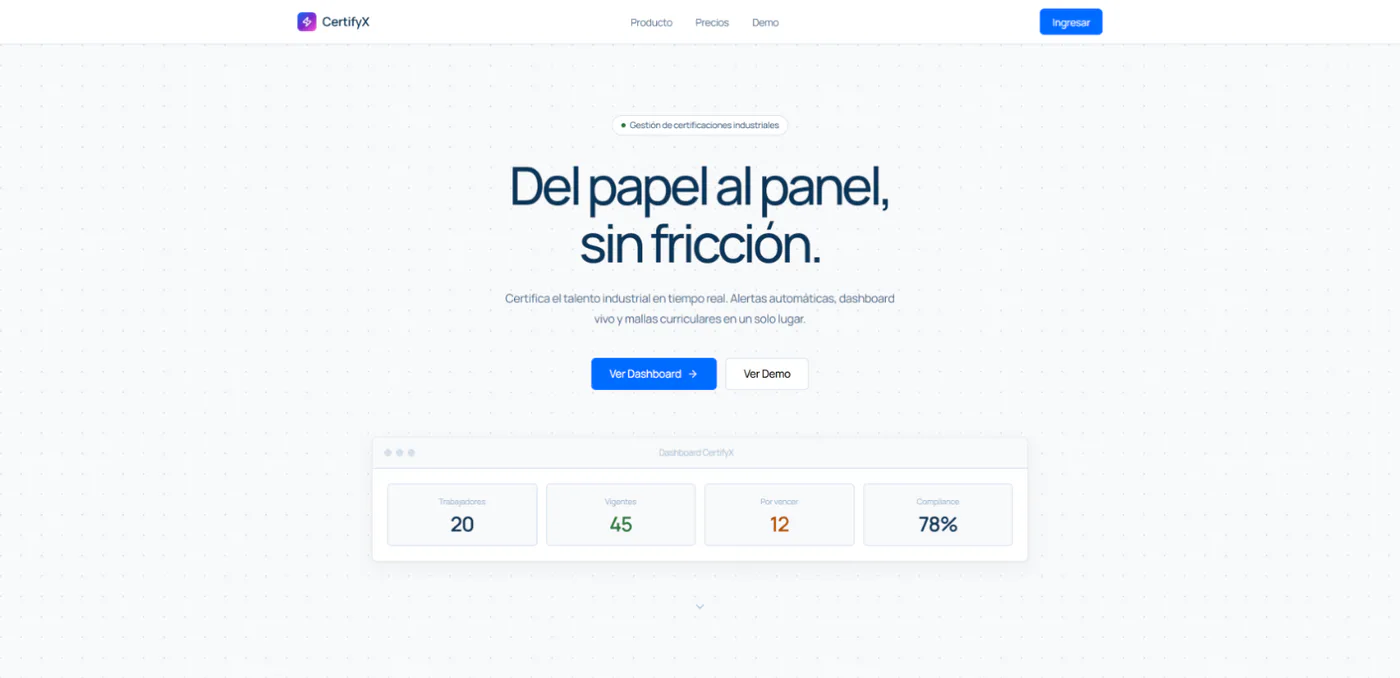
Early exploration: Nexus Control, Sentinel OS's predecessor.
Research
I ran research focused on the mental model of a human operator in autonomous AI systems. The goal wasn't a more complex console but a surface of trust: the interface has to tell the operator where to look, why it matters, and what they can do.
Research activities
- Mapped the agent's 6 operating states and their possible transitions.
- Analyzed the 4 agent profiles and their distinct risk thresholds.
- Designed escalation rules by confidence, economic risk, and cross-dependencies.
- Defined 3 critical demo scenarios to test human intervention.
- Studied exception-based monitoring patterns and circuit breakers.
- Reviewed XAI audit needs: steps, sources, confidence, impact.
Process
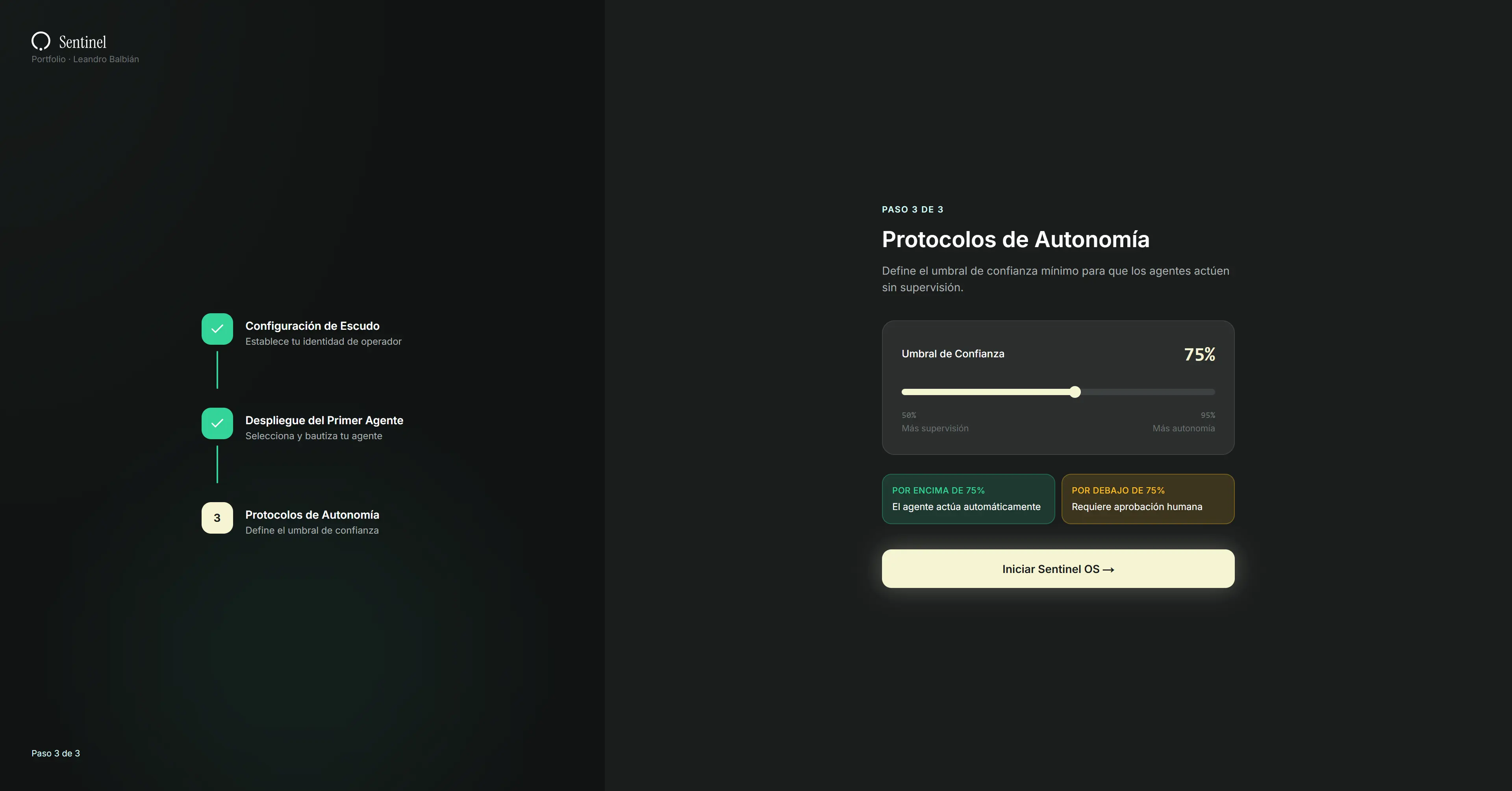
I designed a system of states and tokens that turns AI uncertainty into clear visual signals. Each decision is measured by confidence, economic risk, and blast radius, and the interface automatically surfaces what needs human attention.
Key decisions
- Distinct operating states: idle, running, monitoring, intervention_required, circuit_open, suspended.
- Global autonomy dial: one control to set how much autonomy the operator delegates.
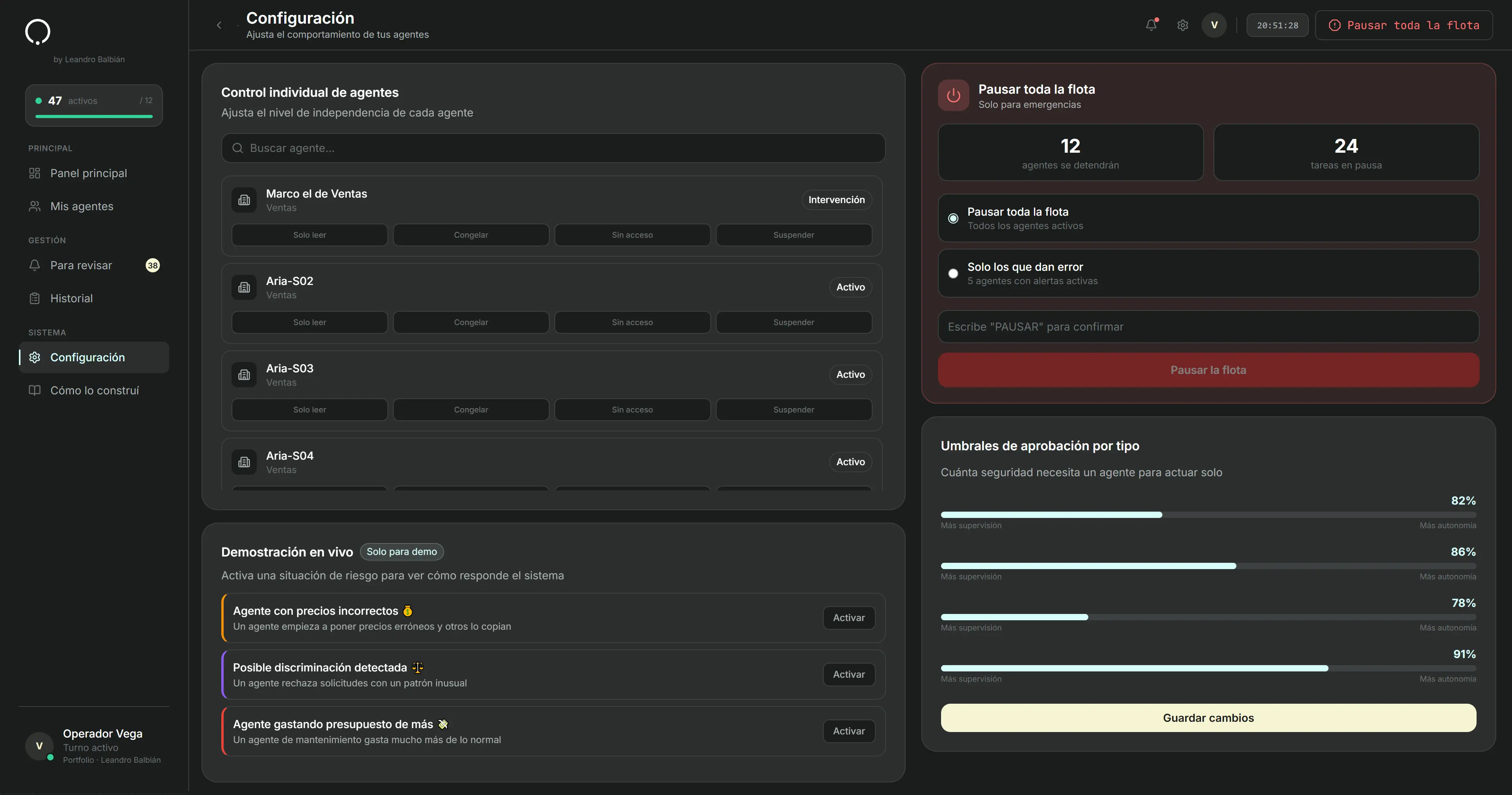
- Per-agent circuit breakers: 4 containment levels per agent (read only, freeze, no access, suspend).
- Exception-based oversight: only decisions that cross the confidence or risk threshold are shown.
- Visual audit trail: each decision breaks down into steps, sources, tokens, and confidence history.
- Dark, technical visual design: high-contrast palette, high-density components, and micro-feedback with Framer Motion.
Token system
How AI uncertainty turns into clear visual signals.
Operating states
The solution
I designed a coordination interface with 6 interconnected sections that share one visual language.
Interconnected sections
- Main dashboard: an instant read of the whole fleet's status.
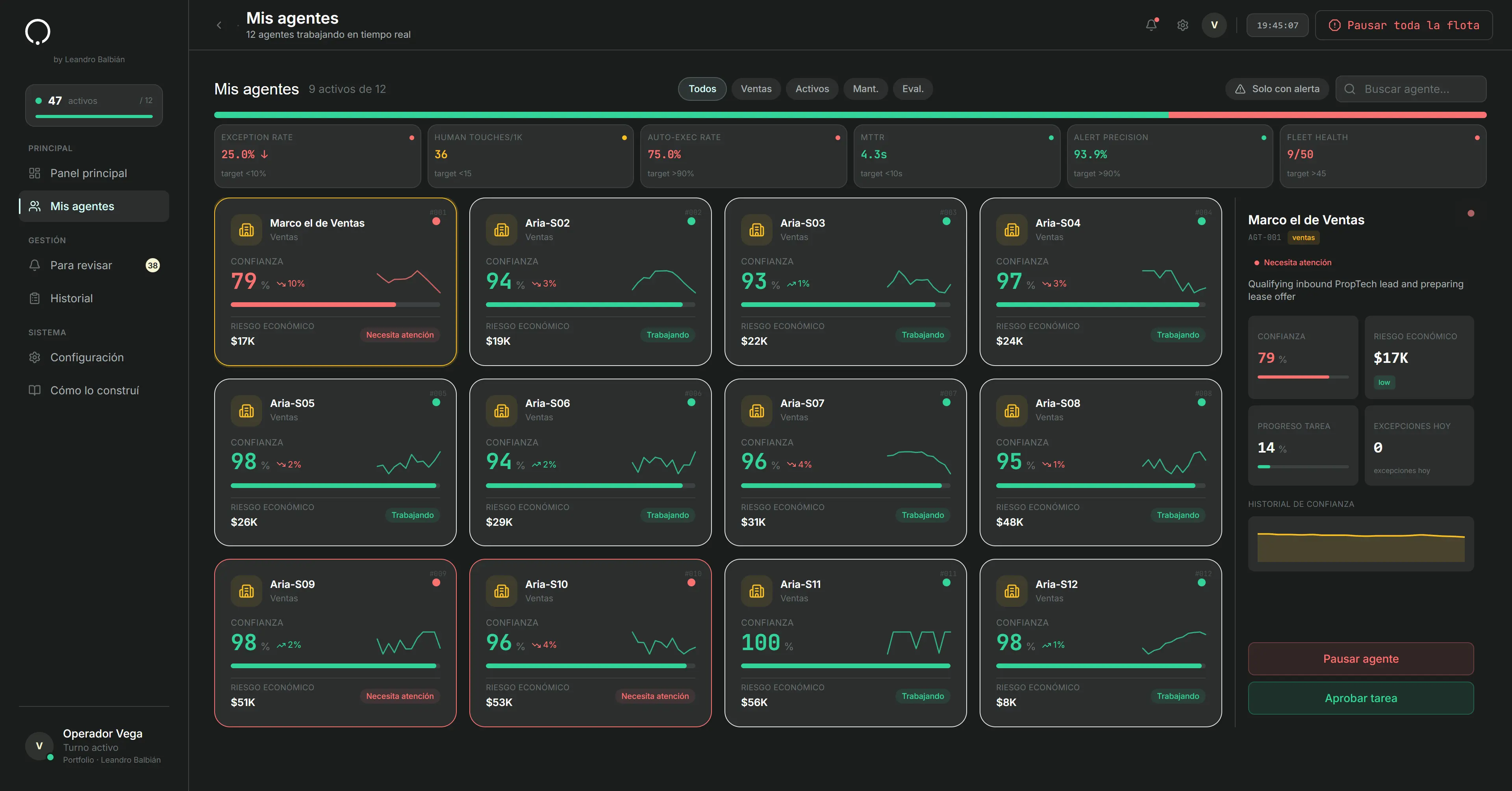
- My agents: the fleet by type, status, confidence, and economic risk.
- To review: an exception queue prioritized by economic impact, with one-click approval.
- Decision history: a timeline of each step, sources consulted, and confidence history.
- Settings: autonomy control, circuit breakers, demo scenarios, and emergency stop.
- How I built it: process documentation inside the product.
Key features
- Real-time monitoring of 12 simulated agents (the system is designed for 50), with ticks every 2 seconds.
- Per-agent confidence score with sparklines and visual thresholds.
- Exception handling with individual approval and rollback.
- Decision audit / XAI: full traceability of why each decision was made.
- Per-agent circuit breakers and scoped emergency stop.
- Live risk scenarios: price loop, screening bias, retry storm.
- Human-in-the-loop intervention without stopping the whole fleet.
My agents
7 active of 12Impact
Sentinel OS reduces operator uncertainty when governing an AI fleet. Attention goes to what truly needs review, while the system keeps traceability and granular control over each agent.
Reflection
Sentinel OS reminded me that AI design isn't about making the machine look human, but about making what it does transparent. Trust in autonomous systems doesn't come from full autonomy, but from the ability to take back control at the right moment.
A clear interface in AI Governance isn't just a dashboard: it's the visual contract between the operator and the fleet.