ABLA
Asking for help at school shouldn't be the hardest part.
ABLA is a digital platform designed to prevent, report, and manage bullying in school communities. It connects students, guardians, and professionals in one ecosystem to ask for help, access guidance, and follow up on cases through a safe and accessible experience.
Context
In a bullying situation, asking for help can mean exposing yourself to classmates, teachers, or adults before you know how to explain what's happening. At the same time, schools, guardians, and professionals need enough information to detect risk, intervene, and follow up.
ABLA grew from that tension: how could a digital space let a student ask for help without feeling exposed while giving adults tools to intervene? The proposal evolved from a student-focused app into an ecosystem with three connected roles: student, guardian, and professional.
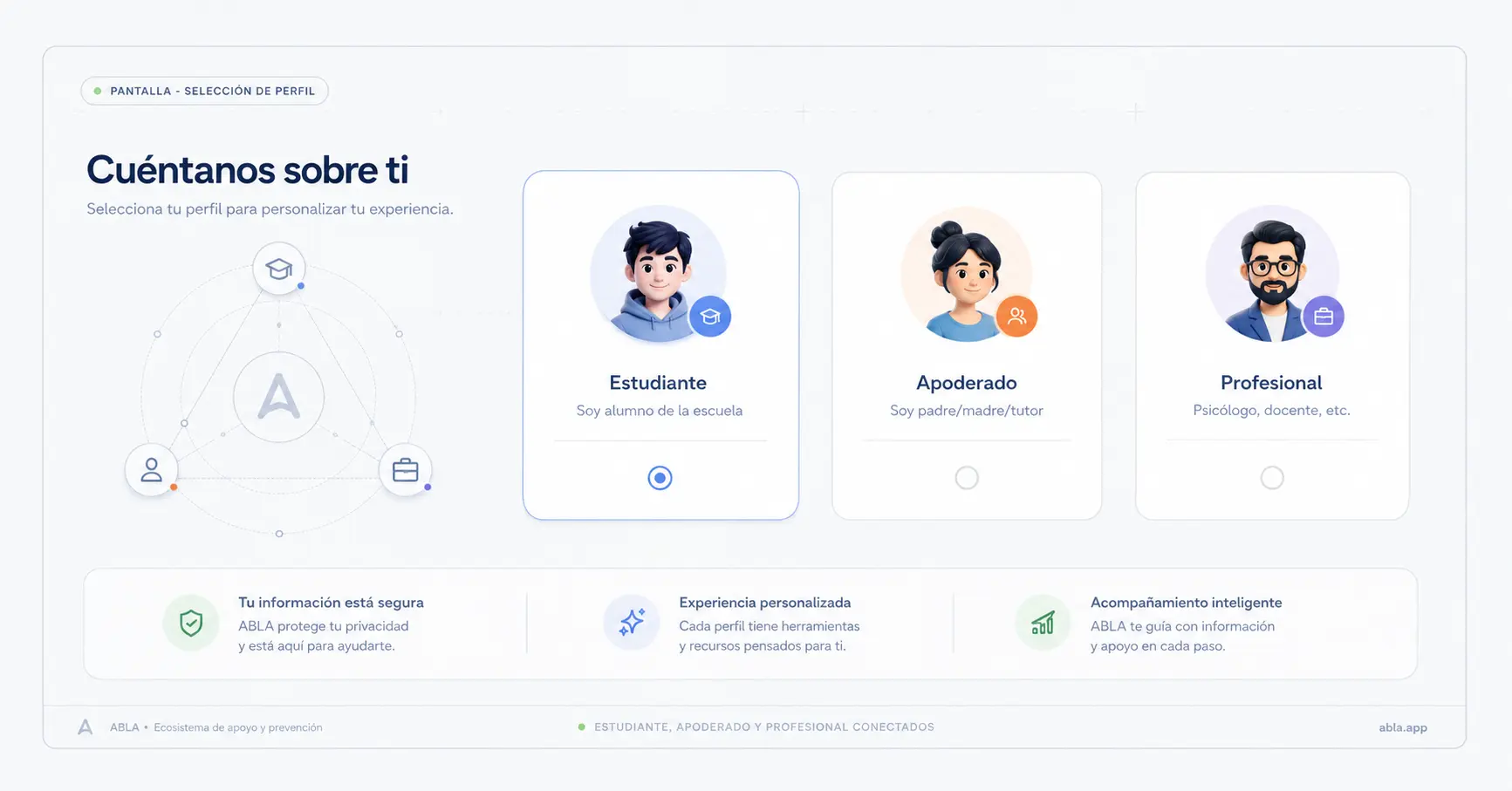
Concept interface shown in Spanish: selecting one of the three roles.
The problem
Traditional channels often depend on a student identifying what is happening, putting it into words, and approaching an adult directly. That barrier can delay detection. Teachers, professionals, and guardians also receive fragmented information without one place to see what happened or which actions were taken.
Friction points
- Fear of exposure: asking for help directly can be difficult.
- Scattered channels: conversations, reports, and follow-up happen in different places.
- Limited options: different situations call for different kinds of intervention.
- Little visibility: after reporting, it's hard to know what is happening.
- Different roles: each role needs a different level of information and control.
- Delayed guidance: finding help can take too many steps.
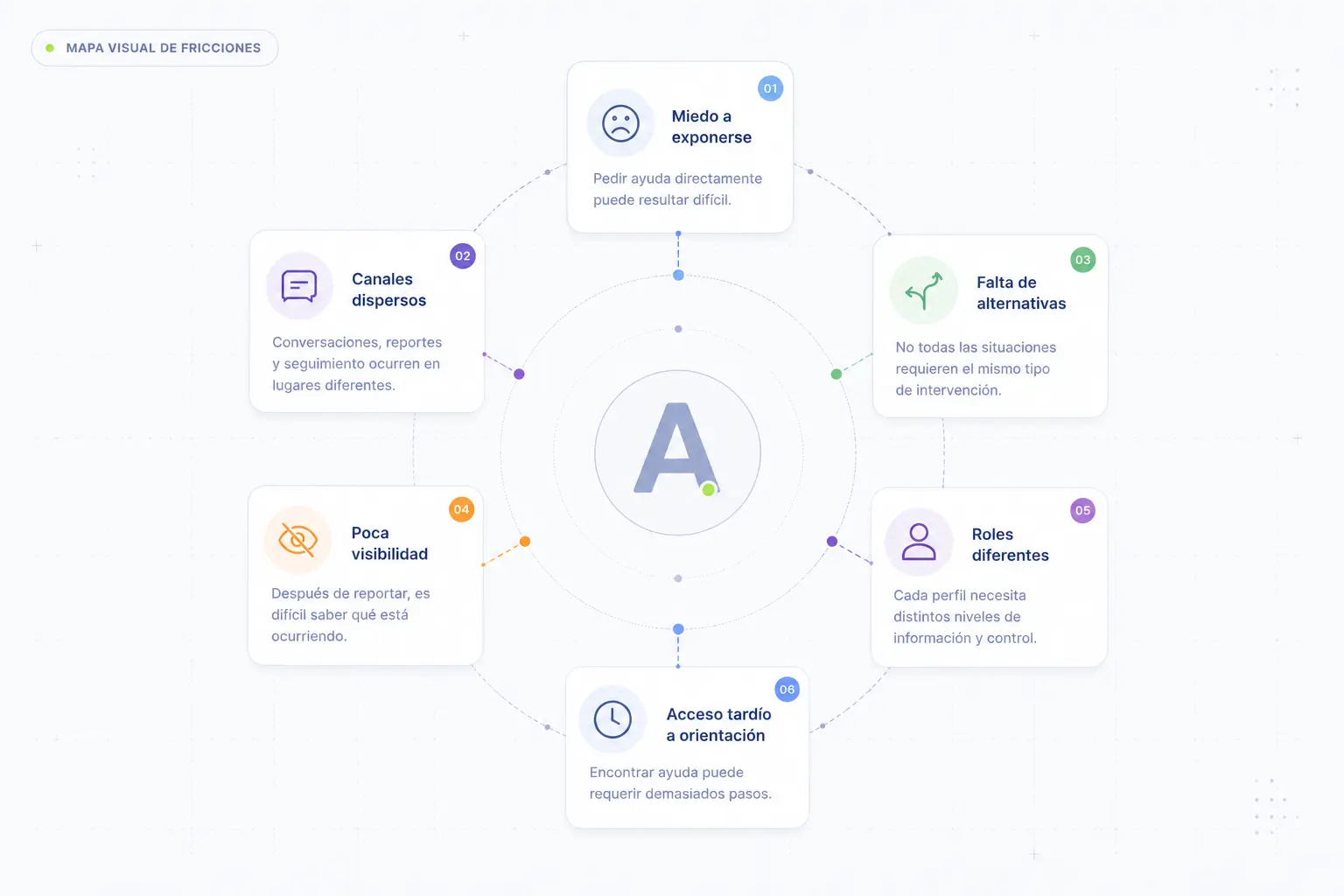
The six friction points are shown in Spanish in this diagram.
Research
The research centered on one question: what does someone need to feel safe enough to ask for help? The analysis showed that the product couldn't depend on a single reporting flow.
Key insight: asking for help isn't one action. The system had to let people start at the level of exposure they were ready for.
Research activities
- Identified the people involved and their needs in a bullying situation.
- Analyzed the emotional barriers to asking for help.
- Identified different levels of intervention.
- Structured help channels by context and urgency.
- Designed reporting, guidance, and follow-up flows.
- Evaluated what information each role needs.
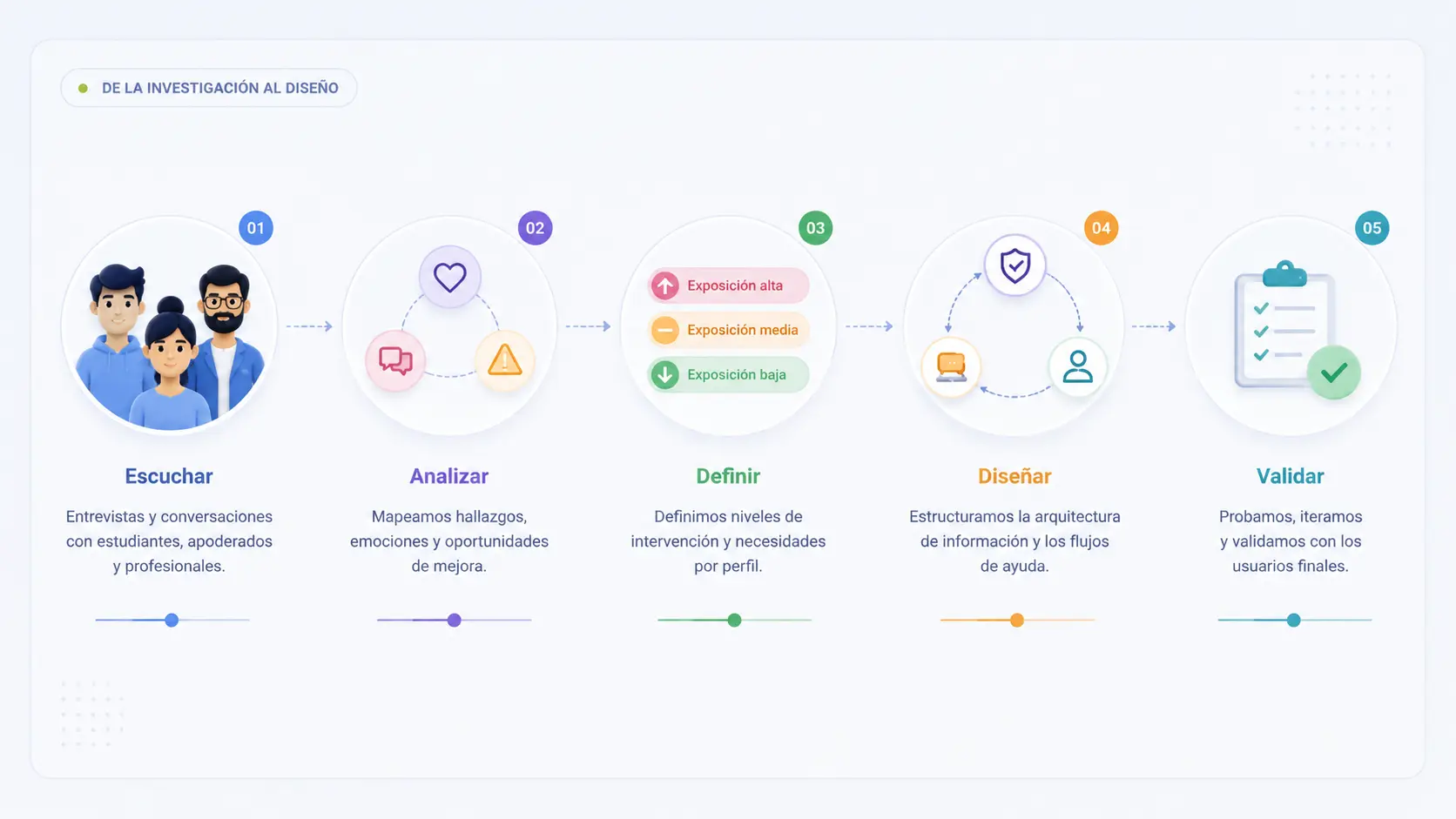
Research diagram shown in Spanish; interviews and end-user testing informed the proposal.
Process
ABLA's structure followed three principles: lower the barrier to entry, adapt the experience to each role, and make reporting a visible process.
Students can begin with lower-friction actions—an anonymous chat, speaking with a tutor, reading advice, or booking an appointment—before filing a formal report. After onboarding, the experience changes for students, guardians, and professionals.
Key decisions
- Progressive onboarding and role selection.
- Anonymous chat as a lower-exposure channel.
- Quick access to help from the main navigation.
- Different report types for different situations.
- A logbook and visual states for case follow-up.
- Access to professionals, appointments, and contextual resources.
- Mobile-first navigation with priority actions always within reach.
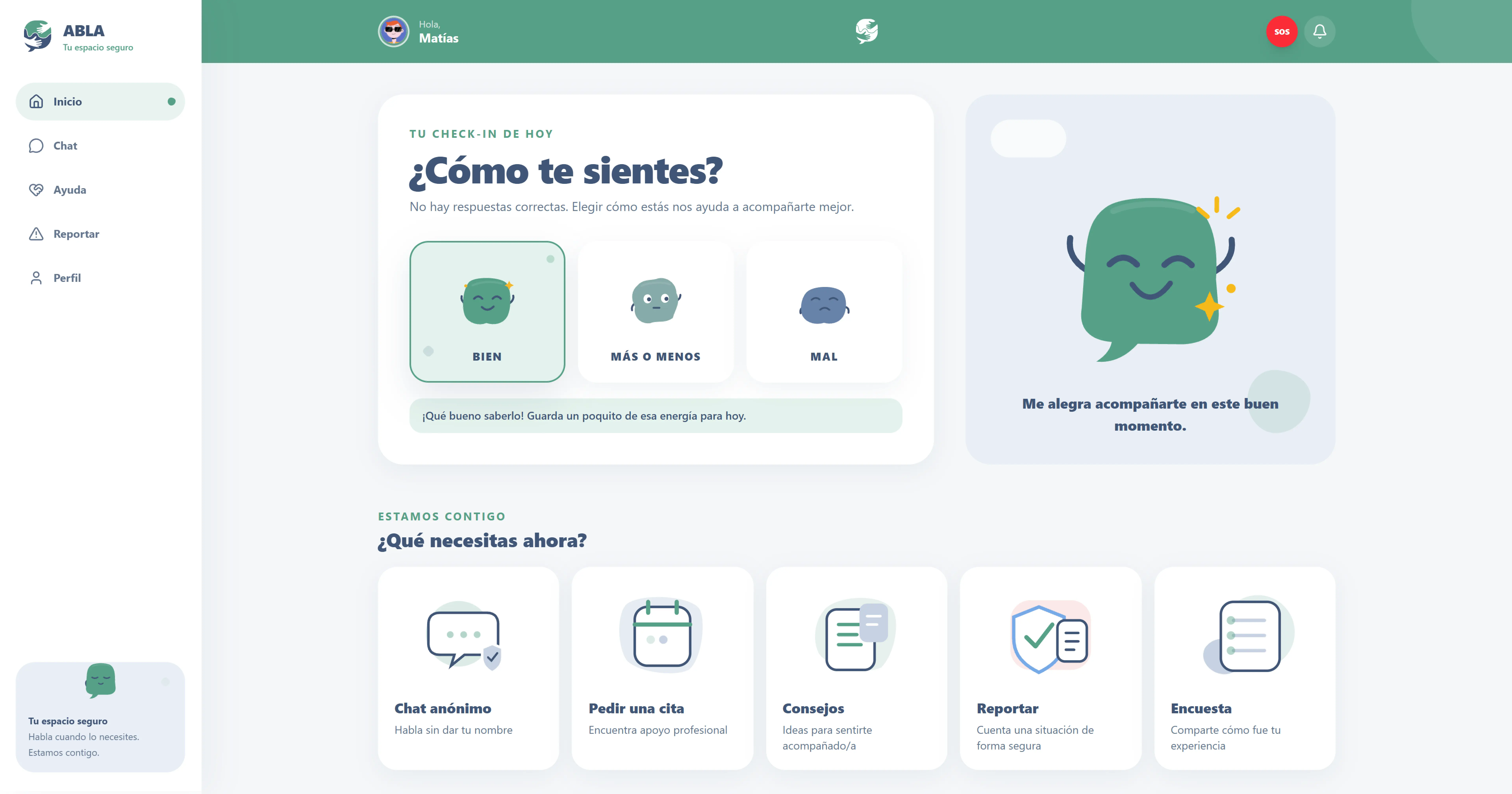
Concept product interface shown in Spanish: emotional check-in and help channels.
The solution
ABLA became a school climate ecosystem where each person has an experience adapted to their role, while everyone participates in the same prevention, communication, and intervention process.
Student experience
- Emotional state and immediate access to help.
- Anonymous chat, tutor, appointments, advice, reports, surveys, and resources.
Safe communication
- Anonymous guidance, chats with a tutor or teachers, group spaces, and the school climate team.
Reports and logbook
- Guided flows for abuse, cyberbullying, and physical violence.
- Six visible states: received, under review, interviews, measures taken, follow-up, and closed.
Guardians and professionals
- Warning signs, guidance, and ways to support the student.
- Cases prioritized by severity, context, state, and referrals.
Help and guidance
- Appointments with professionals, practical advice, help lines, and resources for each role.
Step by step
Tell us what happened
You can remain anonymous.
Outcome
The outcome of the redesign was to expand ABLA from an experience focused on reporting bullying into a system for prevention, communication, intervention, and follow-up. Students, guardians, and professionals can enter the process with different needs within the same platform.
Prevention
Communication
Intervention
Follow-up
3 connected roles
Reflection
ABLA taught me that designing for sensitive situations requires thinking beyond interface efficiency. Reducing a click matters, but reducing the feeling of exposure matters even more.
Designing a safe experience doesn't remove the complexity of the problem. It lets each person approach it from the level of trust they have at that moment.
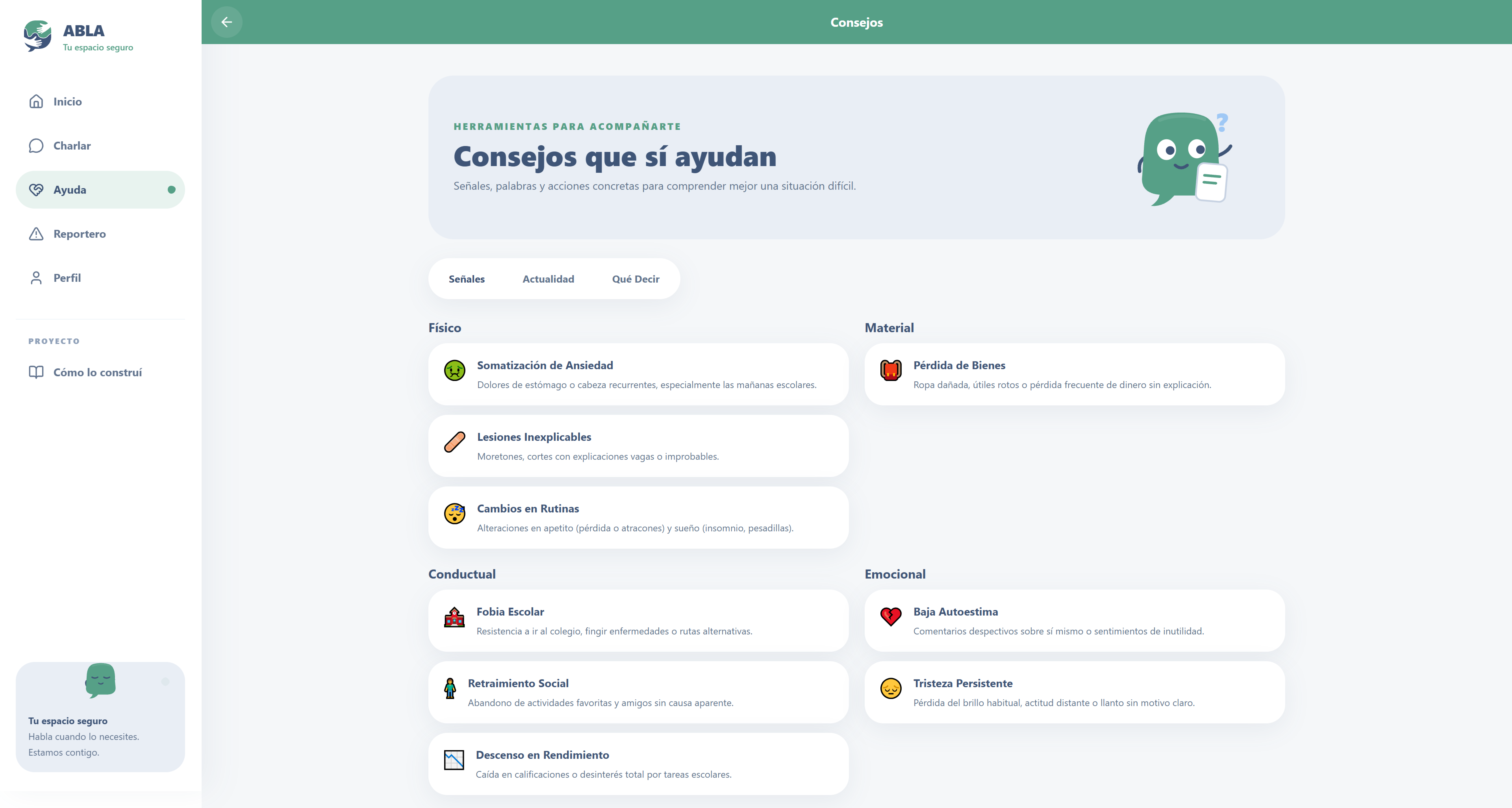
Concept help and guidance interface shown in Spanish.